Posts Tagged ‘Chateauneuf-du-Pape AOC’

A Visit to the Pierre Usseglio Winery

October 23rd, 2012 by Sébastien Gavillet

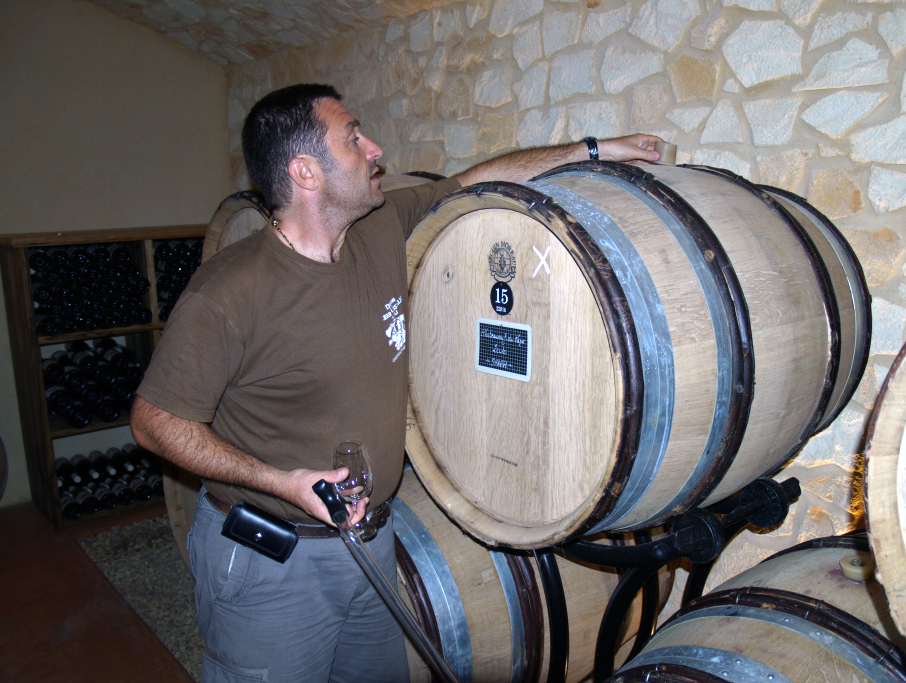
I recently toured the Rhône wine region in the company of France-based American Sommelier, Kelly McAuliffe. Naturally, my wine tour of the region included a visit to Châteauneuf-du-Pape, where I (and company) visited the tasting room of the Fédération des Producteurs de Châteauneuf-du-Pape (FEDCN) to sample some of the wines of the Appellation. After our FEDCN stop, we all headed to Domaine Pierre Usseglio & Fils for a visit with Thierry Usseglio.

The Pierre Usseglio Estate was founded by Thierry’s grandfather, Francis Usseglio, who in 1931 left Italy for Châteauneuf where he got a job as a vineyard worker. In 1948 he acquired his own vineyard and started producing his own wine.

Francis Usseglio had two sons: Pierre and Raymond. Pierre took over the property from his father, while Raymond went on to establish his own estate (Domaine Raymond Usseglio & Fils). Today, Pierre’s two sons (Jean-Pierre and Thierry) run Domaine Pierre Usseglio, which encompasses 21 hectares of vineyards divided into 15 different parcels across the Châteauneuf-du-Pape Appellation.

The Usseglio brothers make excellent wines and are, in fact, one of the best Châteauneuf-du-Pape producers today. For the benefit of those who are not familiar with Domaine Pierre Usseglio wines, here are brief tasting notes on a couple of them:

Domaine Pierre Usseglio & Fils Châteauneuf-du-Pape Cuvée de mon Aïeul

The name of this red wine roughly translates to “Châteauneuf-du-Pape Cuvee of my Ancestor,” which is fitting since this wine is the Usseglio brothers’ tribute to their grandfather’s wine making legacy. A special blend of grapes harvested from carefully selected vines from the winery’s La Crau, les Bédines and/or les Serres plots, this is a Grenache varietal wine (aged 50%  in cement tank, 40% in wooden vats or cuves and the rest in oak barrels).

The wine is day-bright, ruby to purple in color. It presents aromas of bilberry, raspberry, with hints of spices, herbs and grilled meats. On the palate, the wine has medium plus body. It is elegant, beautifully balanced and velvety with silky, perfectly integrated fruit and wood tannins. This is one wine you’ll find very hard to enjoy in moderation.

Domaine Pierre Usseglio & Fils Châteauneuf-du-Pape Réserve des Deux Frères 2009

Like the Cuvée de mon Aïeul, this red wine is bright, ruby to purple in color. It presents aromas of bilberry, blackberry, toast, Indian spice, and herbs with hints of licorice, smoke and truffle. On the palate, the wine is full bodied, rich, very intense, and mineral – a wine I very much look forward to revisiting in a decade.

Cheers!

Châteauneuf-du-Pape

February 07th, 2012 by Sébastien Gavillet

My Rhône Valley trip wouldn’t have been complete without a visit to Châteauneuf-du-Pape. Fortunately, it was part of the itinerary set by Kelly McAuliffe, the France-based, American Sommelier who gave us the delightful tour of the Rhône wine region.

A Brief Background on Châteauneuf-du-Pape

Châteauneuf-du-Pape is a village on the side of a hill overlooking the Rhône Valley and the Rhône River in Southeastern France. It is also a world-renowned Appellation d’Origine Contrôlée (AOC) wine region, which spans the village of Châteauneuf-du-Pape and three other neighboring villages; namely, Bédarrides, Courthézon and Sorgues.

The name Châteauneuf-du-Pape actually means “The Pope’s New Castle,” which refers to the Papal Château that used to tower over the village. This Papal Castle was built in 1320 by Pope John XXII. At that time, the seat of the Papacy was in Avignon instead of Rome (the period from 1309-1378 is commonly known as the Avignon Papacy for this reason). Since the village of Châteauneuf-du-Pape lies between the villages of Avignon and Orange, it was the ideal site for a Papal summer castle; it was close enough to Avignon to make it easy for the Pope to keep an eye on Papal matters, yet it was far enough from the Papal Palace that the Pope could gain temporary respite from the daily pressure of his office.

Today, only ruins remain of the Papal Château in the village of Châteauneuf-du-Pape. Mercenaries looted the castle when Pope John XXII died. The Protestants of Montbrun destroyed it in 1562, the start of the French Wars of Religion. It suffered further damage during the Germans’ retreat in 1944.

Châteauneuf-du-Pape Wine Tasting at FEDCN

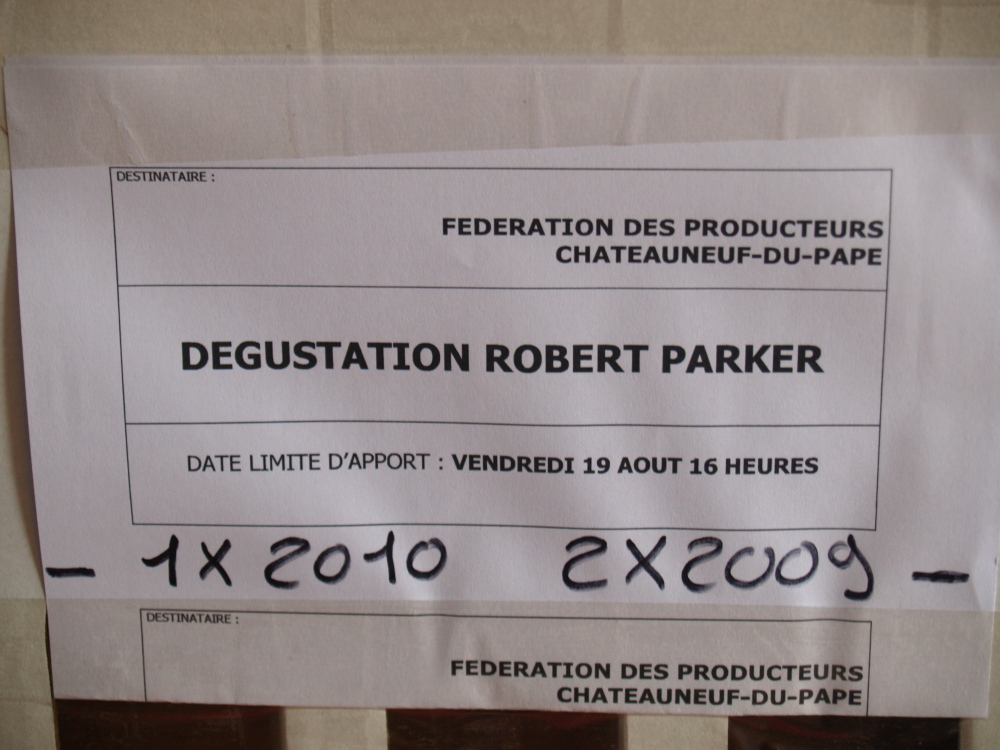
Kelly organized a visit to the Fédération des Producteurs de Châteauneuf-du-Pape (FEDCN) – the organization of Châteauneuf-du-Pape wine producers. The FEDCN is also the place Robert Parker comes to every year to review many of the wines from the region.

As a matter of fact when we arrived at the FEDCN, we were informed that Robert Parker (or “Bob” as the French calls him) is also in town and has just been to the tasting room for a wine tasting. So we all proceeded to the tasting room with Michel Blanc, the director of FEDCN, who invited us to taste the same wines Robert Parker had sampled earlier. That special treat is definitely one of the highlights of my trip.

As we were finishing up with the tasting, we were greeted by the son of Baron Le Roy. For those of you who do not know, Baron Pierre Le Roy de Boiseaumarié was the man behind the proposal to institute the AOC system in France. He wanted to protect the region from wine producers who claimed to produce Châteauneuf-du-Pape wines even though their estates lay outside Châteauneuf boundaries. In 1933, the French Court of Appeal affirmed Châteauneuf-du-Pape’s production regulations that set the Appellation’s production guidelines and boundaries.

I had a truly great time sampling wines at the FEDCN. Our tour of Châteauneuf-du-Pape was far from over, however. We had another scheduled stop: a visit to Domaine Pierre Usseglio & Fils, where we were warmly welcomed by Thierry Usseglio – but that’s a story for another post.

Cheers!