Posts Tagged ‘petite arvine’

Rene Favre & Fils – The Princes of Petite Arvine

May 06th, 2010 by Sébastien Gavillet

My journey into the Swiss wine country included a stop in St. Pierre-de-Clages, a village in the municipality of Chamoson in the canton (state) of Valais. There, I met up with Mike and John (Jean-Charles) Favre of the Rene Favre et Fils (Rene Favre & Sons) winery.

The Wine Region of St. Pierre-de-Clages, Chamoson

The wine-growing area of St.Pierre-de-Clages and Chamoson is the largest in Valais and home to around 30 different wine grape varieties. The soil in this area is mostly limestone. The vineyards are situated on the right bank of the Rhone River, and most of them are on gentle slopes. The unique location of the St.Pierre-de-Clages – Chamoson vineyards gives them a southern exposure that makes the proper maturation of wine grapes possible, and it is at the heart of this exceptionally located wine-growing region that you’ll find the Rene Favre & Fils Estate.

Rene Favre & Fils Winery

The Rene Favre & Fils winery specializes in Petite Arvine wines produced from the world’s oldest Petite Arvine vines. This family winery is currently run and operated by the Favre brothers, Mike and John.

John Favre first studied at the agricultural school of Chateauneuf in Valais. Next, he went to L’ecole Superieure de Changins, the best viticultural and oenology school in Switzerland.

Mike Favre took a slightly different route. He studied Economics before going on to study Oenology and Viticulture in the state’s engineering school. Then, he set off to the US where he lived and made wines for 7 years before returning to Switzerland and the family estate. Today Mike is Vice President of Vinofed, among other things.

Mike and John Favre represent the new generation of winemakers. Bold, forward-looking and passionate about their wines and vines, they are revolutionizing the industry by introducing and applying new techniques to viticulture and winemaking.

The Favre Vines

The Favre vineyards are easily identifiable by the way the vines are planted. Specifically, the vines are arranged into two tight rows and one larger row (see picture gallery).

The vines were planted this way mainly for efficiency. This configuration gives grape pickers better access to the grapes. It also makes the vines more accessible to a specialized machine that removes extra leaves. The removal of extra leaves increases air flow within the canopy. This helps prevent rot and other vine diseases and, consequently, the Favres don’t need to use pesticides on their vines.

The Favre vines are, in fact, some of the cleanest I have ever seen (see it for yourself by checking the picture gallery), and I have seen plenty in my trips to vineyards worldwide.

The Favre Wines and Wine Production

The Rene Favre & Fils winery produces a diverse range of wines. Their white wine production consists mainly of Petite Arvine, Johannisberg (Sylvaner) and Fendant (Chasselas). Their red wine production, in turn, consists mainly of Pinot Noir, Gamay, Humagne Rouge, Merlot, Syrah, and Diolinoir.

All Favre wines are made in the estate, and all of them are fermented in stainless steel vats. Most of the whites never see oak, but all the reds do. The profiles of Favre wines are typical of the region, with the exception of a few blends which Mike and John have produced for a more international palate.

My personal favorite in the Favre white wine lineup is the “old vines” Petite Arvine (i.e. Petite Arvine wine made with grapes harvested from very old Petite Arvine vines). This wine is fresh with a medium body and balanced acidity. It has the aromas of lemon, grapefruit rind and rhubarb and some floral notes, too. It also has noticeable minerality (limestone) on the palate and a pleasant touch of salinity.

My favorite Favre red is the Renommée St. Pierre, which is surprisingly rich and fruit driven for a Suisse Pinot Noir. This is wine aged for 18 months in oak, and I highly recommend it to any Pinot lovers.

This is all for now. Watch out for more posts about Swiss winemakers and Swiss wines. In the meantime, you can read the first two installments in the Swiss wine series: Swiss Wine Facts and The Adrian and Diego Mathier Winery.

Cheers!

Swiss Wine Facts

March 17th, 2010 by Sébastien Gavillet

Not much is known about Swiss wine outside of Switzerland. When people think of Switzerland, they usually think of skiing, chocolates, cheeses, watches, and private banking, among other things. Where does wine fit into all this, and why don’t we know much about it?

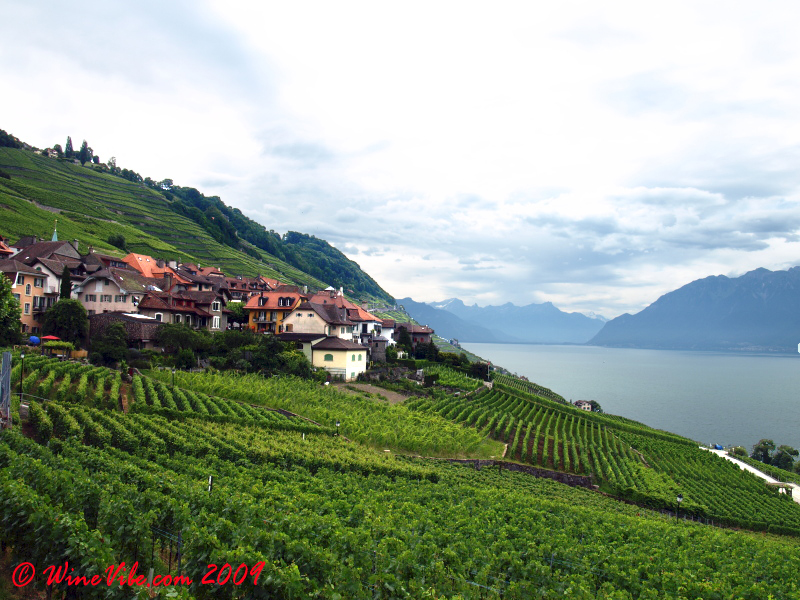
lavaux vineyards
Vineyards of Lavaux , Vaud, Switzerland

How much wine does Switzerland produce?

To put Switzerland’s wine production into perspective, I will compare it with California. Switzerland produces around 1.1 million hectoliters (29 million gallons) of wine a year. California, on the other hand, produced around 20.6 million hectoliters (545.8 million gallons) in 2008. In other words, Swiss wine production is only around 5% of California wine production. Clearly, Switzerland’s wine production is significantly less than California’s. Nevertheless, if you figure in Switzerland’s population, you’ll realize that Switzerland actually produces a lot of wine. Specifically, it produces more than 4 gallons or 21 bottles of wine per inhabitant.

How much wine does Switzerland export?

Over 4 gallons of wine per capita seems plenty, especially since people below 18 normally do not drink wine. Switzerland probably exports most of it – or does it, really? Well, it does not. Swiss wine export is actually very limited. It’s just supply and demand. Swiss people drink 4 times more wine than Americans do. In fact, Switzerland has to import around 1.7 million hectoliters of wine (45 million gallons) just to satisfy its people’s demand for wine. In short, residents of Switzerland love their wines so much that they leave very little available for export. Switzerland exports only 1.5% of the wine it produces. In contrast, according to the US Department of Commerce, California exported over 21% (3.8 million hectoliters or 100 million gallons) of its wine production in 2006. So, why do we know so little about Swiss wine again? Simple. Virtually all of it is consumed domestically. Not a lot of people outside Switzerland get to try it, let alone know about it.

Interesting trivia: Even though the demand for Swiss wine is very high, Swiss wine prices remain reasonable. Most Swiss wines are priced at the $12-$30 range.

Swiss wine varietals

Switzerland is most well known for growing Chasselas, a white grape variety often used as a table grape in Europe. For some reason (climate/soil), Chasselas has found a perfect home in Switzerland. Swiss Chasselas wines are delicate and elegant with great minerality. At first, it was thought that all Swiss Chasselas wines are best drunk young (within the first 2 years). However, sommeliers have discovered that some Chasselas wines 15 years and older from great producers and vintages actually drink very well. These vintages are creating beautiful, mature Chenin Blanc/Viognier-type wines. Switzerland is home to many indigenous varietals and has cross-cloned numerous varietals as well. Some 190 varietals are grown in Switzerland today. The most commonly cultivated are (in order of importance and categorized by wine type):

Reds:

Pinot Noir (52%), Gamay (19%), Merlot (12%), Gamaret (4%), Garanoir (2%), Syrah (2%)

Humagne Rouge, Diolinoir, and some fifty plus, non-listed varietals account for 9%

Whites:

Chasselas (66%), Muller-Thurgau (8%), Chardonnay (5%), Sylvaner (4%), Pinot Gris (2.5%)

Amigne, Pinot Blanc (Malvoisie), Charmont, Humagne Blanche, Petite Arvine, Riesling, Gewürztraminer, Heida (Paien) and some seventy or so non-listed varietals account for 14.5%

Swiss vines go back as far as 3,000 BC. According to records, Swiss viticulture and wine production began at the time of the Roman Empire. We owe today’s incredible terraces of vineyards in the Lavaux area to the monks. Some of these vineyards are now UNESCO World Heritage sites (enlisted/inscribed in 2007, UNESCO ref 1243).

More Swiss wine facts and trivia to come

This is just the start. Expect more blog posts about my trip into the heart of Switzerland’s wine production areas.

Cheers!