Posts Tagged ‘Swiss wine’

Swiss Fondue and Raclette at Charlie Palmer’s Third Annual Aureole Wine Weekend

August 13th, 2011 by Sébastien Gavillet

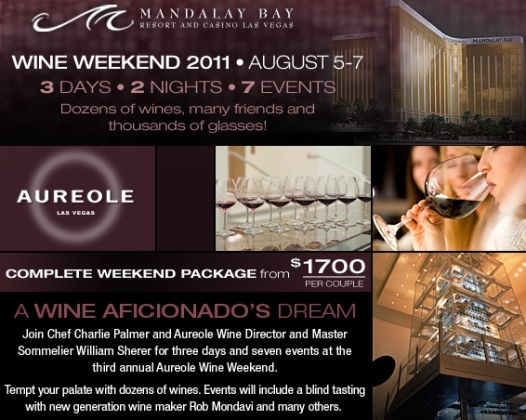
It is one thing to make fondue for a few people but making fondue simultaneously for 50 or more people is no easy feat. Nonetheless, it can be done and it has been done. It was just last weekend, in fact, during the Swiss Fondue Party, the 7th and final event of the 2011 Aureole Wine Weekend held at Aureole Las Vegas in Mandalay Bay Resort & Casino last August 5-7, 2011.

The 2011 Aureole Wine Weekend is the third of its kind since 2009. The organizer is Charlie Palmer and the Charlie Palmer Group (owner of top restaurants Charlie Palmer, Charlie Palmer Steak, Dry Creek Kitchen and Aureole).

The Aureole Wine Weekend takes place once a year (on a weekend, of course). It is, to borrow the organizer’s own words, “a wine aficionado’s dream.” Several individual events take place throughout the weekend, during which time attendees get to sample hundreds of wines. Charlie Palmer’s most loyal gourmands are treated to course after course of heavenly dishes prepared by Aureole’s Executive Chef Vincent Pouessel and impeccably paired with wine by none other than Aureole’s Wine Director, Master Sommelier William Sherer.

What did I get myself into?

Well, this year, William Sherer and Aureole’s GM Kevin Dimond wanted to spice things up. They wanted to try something fun and less formal for the last day of the Wine Weekend, thus the Swiss Fondue Party I was telling you about earlier. They asked me if I wanted to help them organize the said fondue party.

I had concerns, naturally. Again, making fondue for a few people is easy but making fondue for more than 50 people is a lot more challenging. It requires proper execution and impeccable timing.

William Sherer assured me that this would not be a problem. Chef Vincent Pouessel and his staff would be on top of everything. Executive Pastry Chef Megan Romano would be there to assist as well. With such an experienced team behind me, the execution could be nothing but flawless. The opportunity to prepare fondue, Raclette and present Swiss wines at one of the top fine dining restaurants in Las Vegas, moreover, is not something that comes around everyday. How could I refuse, really? So I accepted. But I was still worried, of course.

D-Day: Swiss Cheese, Swiss Wine and Friends

August 7th, the day of the fondue party, finally arrived. The day began with a Bouillabaisse Breakfast, Sunday’s first event and the 6th of the seven Aureole Wine Weekend events. It was nothing like any breakfast I’ve had before. Aside from the fact that the food was extremely good, it was a breakfast paired with 7 Rieslings. Yes, that’s 7 glasses of Riesling – for breakfast.

After the Bouillabaisse Breakfast, we headed down to the kitchen to start preparations for the Raclette as well as the Cheese and Chocolate Fondue. When I walked into Aureole’s kitchen and saw the army of cooks working so capably and efficiently under Chef Vincent Pouessel’s supervision, my worries eased.

As an aside, Aureole’s kitchen is a sight to behold. It’s almost bigger than my entire house. It’s so big that Chef Vincent Pouessel actually uses a microphone when things get loud in the kitchen. Even Remy, the mouse from Ratatouille, would have been impressed!

Anyway, after my amazement has sufficiently passed, we started our preparations for the fondue party. The cheeses for the Raclette needed to be cleaned and the wheels cut into halves. The cheeses (Gruyere and Emmenthal) for the fondue needed to be grated, mixed and placed in fondue pots. Wine, garlic, kirsch eau-de-vie, pepper and other fondue ingredients (Chef Walti Wegmann’s recipe) also had to be prepared.

Christophe Tassan (MOF and the Wine Director of Mandalay Bay properties – e.g. Mandalay Bay, THEhotel, Four Seasons and Socialite), William Sherer and I started uncorking the wines to prepare them for service. Each wine had to be sampled to ensure that no faulty wines would be served. It was also the perfect moment to catch up with two close friends who are often so busy we rarely get the chance to get together for a little chat and a glass of wine.

Then it was time for the Swiss Fondue Party. The guests made their way back into Aureole’s dining room and, once they were properly seated, the fondue party officially started. We started the meal with cold cut meats, and the first flight of wines was served. Chef Vincent Pouessel’s team started making the fondue. The Raclette machines were turned on and the wheel halves were placed in cheese holders. That was my cue to start my presentation about Swiss wines and Switzerland’s recent wine “R”evolution.

1st flight: Dry Swiss White Wines

Wine 1: Domaine E. de Montmollin Fils Neuchâtel 2009 for the Fondue/Raclette

Made from the Chasselas grape, this wine comes from an award-winning winery managed by brothers Pierre and Jean-Michel de Montmollin. The de Montmollin family owns four estates: Auvernier, Areuse, Chauvigny and la Brosse, all of which are on the north bank of Lake Neuchatel.

Tasting notes: This Neuchâtel is refreshing with its fresh lime-tree fragrance, vine blossom aromas, distinct mineral notes, and citrusy flavor.
Pairing: Like all Chasselas wines from Domaine E. de Montmollin Fils, this Neuchatel is perfect as an aperitif. It’s great with Raclette and fondue (of course) but you should also try it with seafood, cold cuts and cheese.
Varietal: Chasselas
Appellation: Neuchâtel

Wine 2: La Baudelière Yvorne 2008 for the Fondue/Raclette

This Chasselas wine comes from a family-owned winery in Yvorne, which is part of the Chablais wine region in Switzerland’s Canton of Vaud.

Tasting notes: Intense aromas and flavors (but not overwhelmingly so) with distinct mineral notes. This is a very elegant wine. Dry (as expected of a Chasselas) with a delicate finish.
Pairing: This wine is great as a starter drink. Like the Montmollin Neuchâtel, this Yvorne pairs extremely well with cheese and seafood.
Varietal: Chasselas
Appellation: Yvorne

Wine 3: René Favre & Fils Petite Arvine Chamoson 2007 for the Raclette

This excellent expression of the Petite Arvine grape comes from a family-owned winery based in St. Pierre-de-Clages, Chamoson in the Canton of Valais. The René Favre & Fils winery is currently under the management of brothers Mike and John Favre.

René Favre & Fils specializes in old-vine Petite Arvine wines; in fact, the René Favre & Fils Estate is home to the world’s oldest Petite Arvine vines. Learn more about René Favre & Fils and its wines in one of my winery visit posts, René Favre & Fils – The Princes of Petite Arvine.

Tasting notes: This wine presents fruity, fresh and citrusy (even tart) aromas with floral notes. It is soft and mellow with mineral hints, has great balance and structure and finishes with a slightly salty tang.
Pairing: This can be served as a starter drink or paired with seafood, poultry dishes and veal. Spectacular with aged cheeses.
Varietal: Petite Arvine
Appellation: Chamoson

2nd Flight: Semi Sweet to Sweet Swiss White Wines

Wine 4: Jean-René Germanier Amigne de Vétroz Valais 2008

A superb expression of the Amigne varietal, this award-winning wine comes from a family winery founded in 1886 and based in the village of Vétroz in Switzerland’s Canton of Valais.

Tasting notes: Fresh and fruity on the nose, this wine is lightly tannic (remarkable for a white wine), slightly sweet, polished, and perfectly balanced.
Pairing: This wine is great as an aperitif but is divine with foie gras and sweets (dessert).
Varietal: Amigne
Appellation: Valais

Wine 5: Jean-René Germanier Mitis Amigne de Vétroz Valais 2007 for the Chocolate Fondue and accoutrement prepared by Executive Pastry Chef Megan Romano

A complex and layered expression of the Amigne varietal, this award-winning wine from Jean-René Germanier was aged in oak for 18 months.

Tasting notes: Sweet with hints of honey and candied / ripe fruits. Rich, intense and complex, presenting multiple layers of flavors that complement and are consistent with its aromas. Great structure and perfectly balanced.
Pairing: An extremely enjoyable dessert wine. Perfect pairing with blue cheeses and fruit-based desserts. Also pairs well with foie gras.
Varietal: Amigne
Appellation: Valais

Wine 6: Provins Valais Maître de Chais Grains de Malice Valais 2008 for the Chocolate Fondue and accoutrement prepared by Executive Pastry Chef Megan Romano

This award-winning late-harvest wine is a blend of Marsanne and Pinot Gris aged in oak for 15 months.

Tasting notes: A subtly layered and complex wine with flavors consistent with its aromas. Balanced and elegant.
Pairing: Pairs extremely well with desserts in general and blue cheese and foie gras in particular.
Varietal: 90% Marsanne, 10% Pinot Gris
Appellation: Valais

An Open Invitation

The Swiss Fondue Party last August 7th was a great success, thanks to Chef Vincent Pouessel, Pastry Chef Megan Romano and their staff. As William put it, “Fondue has not been this much fun since the 70’s.” As for the wines, well, there was not a drop of wine left over at the end of the event. They were that good!

To anyone out there who considers himself a gourmand: the Aureole Wine Weekend is the food and wine pairing event you should not miss. It is worth so much more than it costs. In fact, it is an absolute bargain! I’m already looking forward to next year’s wine weekend. If I’m in town then, I’ll definitely be attending, although I’ll be sure to come as one of the guests next time (less stress, even more fun).

Bon Appétit and Cheers!

Acknowledgments:

The Swiss Fondue Party wouldn’t have been the great success it was if it weren’t for the invaluable assistance of Aureole’s Executive Chef Vincent Pouessel, Aureole’s Executive Pastry Chef Megan Romano and every member of Aureole’s highly professional staff. I owe you all a big thank you.

Where you can go for additional information about the Third Aureole Wine Weekend and its participants:

  • The Third Annual Aureole Wine Weekend in Las Vegas Program
  • http://www.charliepalmer.com/Data/Documents/Aureole%20Wine%20Weekend%202011.pdf

  • Aureole Las Vegas
  • http://www.charliepalmer.com/Properties/Aureole/LasVegas/

  • Aureole Las Vegas Staff
  • http://www.charliepalmer.com/Properties/Aureole/LasVegas/Staff/

  • Executive Pastry Chef Megan Romano’s website
  • http://www.chefmeganromano.com/

Where you can go for more information about the Swiss wines listed above, all other Swiss wines, and places in the USA where you can get Swiss wines:

  • Swiss Cellars
  • http://www.swisscellars.com

  • Swiss Cheese
  • http://www.swissfaves.com

Swiss Wines in the City – New York City

May 26th, 2010 by Sébastien Gavillet

It was a rare treat for Swiss wine lovers. On May 3rd, Swiss Wines in the City was held at the City Winery in New York City.

The Concept:

Leave it to the Swiss to come up with such a fantastic and original idea: a wine bottling party to promote Swiss wines in New York City! Swiss wine journalist Chandra Kurt came up with the idea. She then pitched her proposal to two world-renowned Swiss wineries, Jean-René Germanier and Provins, both of which graciously consented to have their wines bottled in a special event at the City Winery.

The Venue:

The City Winery, located at the heart of Soho, is the only winery in the City of New York. It was founded by Michael Dorf in 2008. It is a fully equipped winery, producing wines using wine grapes from all over the world. French winemaker David Lecomte heads the City Winery’s professional wine making team. Next time you are there, try his Petite Syrah. You’ll find it hard to believe you’re drinking wine made in NYC. The City Winery is a great place for hanging out. It is place where people can get together, enjoy wines produced on-site and listen to live music. Artists like Suzanne Vega and Elvis Costello have performed there. Want to try your hand at wine making? The City Winery also offers aspiring wine makers and hobbyists the opportunity to make their own wines.

The Wines:

Two wines, one from each participating Swiss winery, were selected for bottling. One of them is a white wine, a Petite Arvine “Cru des Domaines” 2007 from Provins. The other is a red wine, a Syrah “Cayas” 2008 from Jean-René Germanier (see Jean-René Germanier Winery post for my Cayas wine review and tasting notes).  A barrel of each wine was shipped to NYC with the help of Laurent Crolla of Swiss Cellars, a distributor of Swiss wines in the United States.

The Party:

Winemakers, sommeliers, wine experts, gourmands, wine importers, wine enthusiasts, and members of the media were amongst those invited to attend this first-of-its-kind event for Swiss wines. Swiss Wines in the City started with a “bottling party.” It went exactly as you imagine: the wines described above were bottled right in front of the guests. After the bottling party, there was a dinner party. The guests were then able to sample a wide variety of wines from the cellars of Provins and Jean-René Germanier.

After Party:

After dinner, we headed to Terroir, Paul Grieco’s latest wine bar and a top NYC hot spot located in Tribeca. We were just in time to share some of the Swiss wines with sommeliers and food critics from all over the country who had just attended the 2010 James Beard Foundation Awards. Cheers!

Jean-René Germanier – Switzerland’s Premier Boutique Winery

May 19th, 2010 by Sébastien Gavillet

As I continued my journey into the heart of Switzerland’s only Grand Cru wine making area, I met up with Gilles Besse of Cave Jean-René Germanier. He is, in my humble opinion, one of Switzerland’s top wine makers.

The Jean-René Germanier Winery

La Cave Jean-René Germanier was established in 1886 when Urbain Germanier planted his first vineyards and founded a winery in Vétroz, a small village at the very heart of Valais (see the post about Rene-Favre & Fils Winery for more information on this region). Today, 3rd- and 4th-generation oenologists Jean-René Germanier and Gilles Besse produce wines that rival those of the world’s best producers, although Jean-René Germanier – while still very much involved and passionate about wines – now spends most of his time playing politics as he is a member of the Swiss Parliament. Apart from wines, the Germanier Estate is also known for its remarkable eau de vie (i.e. fruit brandy). Another Germanier ancestor, Francis Germanier, was the first to make eau de vie from the now-famous Williams pears, giving birth to Germanier Estate’s Bon Père William.

The Germanier Wine Varietals

The Jean-René Germanier Estate produces both white wines and red wines. The following is a list of the grape varieties used in making Germanier wines:

White wine varietals

Red wine varietals

Remarkable Germanier Wines

Jean-René Germanier & Gilles Besse have achieved star status in Switzerland and around the world for their superb, award-winning wines. Cayas, Champmarais and Mitis are just three of these notable Germanier wines.

Cayas Syrah Du Valais: Wine Review and Tasting Notes

Cayas Syrah Du Valais is a Syrah varietal red wine. It resembles any great Rhône Côte-Rôtie or Crozes-Hermitage wines, but surpasses most of them.

Cayas has an intense garnet robe. It is very elegant; the nose is complex yet surprisingly delicate for such a full-bodied wine. It presents the aromas of blackcurrant, blackberry, redcurrant, some spice (with hints of licorice and pepper), leather, vanillin, and a touch of earthy mineral-like notes.

There’s an almost-perfect balance between acidity and tannins, which gives Cayas a surprisingly crisp and harmonious finish for a Syrah. To put it simply, this is the type of wine you can drink, glass after glass, without having to force yourself one bit.

Proof of its excellence can be seen in all of its awards. Among its many awards is a Gold Medal in Vinalies Internationales Paris and a Gold Medal as well as the distinction of being one of the Top 10 Best Syrahs in Syrah du Monde 2009. It is also the only Swiss wine you’ll find in the wine list of the famous La Tour d’Argent in Paris.

As you all know, the purpose of my visit into the Swiss wine country is to introduce you and the rest of the world to unique Swiss wines. As remarkable as Cayas is, it’s still a Syrah varietal – and Syrah is not a grape variety native to Switzerland.

If you are hankering for wines uniquely Swiss, then you’d love my discussion of the next two Germanier wines: Cornalin de Champmarais and Mitis Amigne De Vétroz.

Cornalin de Champmarais: Wine Review and Tasting Notes

Cornalin de Champmarais is a red wine. As its name suggests, it is made using the Swiss wine grape, Cornalin.

Now, as anyone who has had Cornalin wines would tell you, wines made of Cornalin often have a great nose and superb finish but tend to be lacking on the mid-palate. Not this time, though. You’ll be pleasantly surprised with Champmarais, which embodies all of the positive characteristics of the Cornalin varietal but none of its faults. No wonder Cornalin de Champmarais belongs to the growing list of Germanier wines with a Gold Medal from Viniales Internationales Paris.

Cornalin de Champmarais owes its full body from superior wine grapes and a unique fermentation and maturation process. At Cave Jean-René Germanier, the grapes used all come from a single vineyard, ensuring great grape quality control. These select Cornalin grapes are fermented in 400-liter barrels made of new oak. The resulting wine is then aged, again in 400-liter new oak barrels for 2 years.

Champmarais is a day-bright, pigeon-blood-red wine with purple hues. It is a rich, complex and highly fragrant wine with excellent aging potential. It presents the aromas of raspberry, blackcurrant, morello cherry, and hints of spices (peppercorn, vanilla). On the palate, the wine is elegant and velvety, with the fruit and wood tannins perfectly integrated. This is one wine you’ll find very hard to enjoy in moderation.

Mitis Amigne De Vétroz: Wine Review and Tasting Notes

Mitis Amigne De Vétroz, an Amigne varietal white wine, is another premium wine from the Germanier Estate. This sweet dessert wine, made using botrytised grapes, is aged on its lees in new oak for up to 18 months. It can rival any top-of-the-line Austrian and German wine of the same style. In fact, Mitis Amigne De Vétroz 2007, has just been awarded a Gold Medal in Vinalies Internationales Paris 2010.

This amber-colored, full-bodied wine presents the aromas of quince comfits, linden, honey-roasted hazelnuts, a touch of Cointreau-like orange peel, and a hint of vanilla bud. This succulent wine enrobes your entire palate, leaving a smooth but lingering caramel or toffee finish. In a word, Wow! Just writing about it is making me salivate.

The Germanier Cellars and Winery

All Germanier wines are made, aged and bottled at the Germanier Estate. Red and white wines are kept separate, and each has its own dedicated “caretaker.” The Jean-René Germanier Winery is a modern production facility. It has undergone some renovations over the years to meet the ever-increasing demand for its wines. More changes are expected to be instituted in the near future.

Germanier wines are available for sale at the tasting room, which is elegant and spacious enough to accommodate large parties. If you are ever in the neighborhood, I urge you to take the time to visit the Jean-René Germanier Winery and sample its wines. You can tell them I sent you.

Just one thing, though: please drink responsibly. There are just so many great wines in that tasting room you’ll find it very hard to spit all of them out. Can’t or won’t take my word for it? You can ask my father who was with me on this particular visit. Let’s just say he had a little too much to drive… Cheers!

Rene Favre & Fils – The Princes of Petite Arvine

May 06th, 2010 by Sébastien Gavillet

My journey into the Swiss wine country included a stop in St. Pierre-de-Clages, a village in the municipality of Chamoson in the canton (state) of Valais. There, I met up with Mike and John (Jean-Charles) Favre of the Rene Favre et Fils (Rene Favre & Sons) winery.

The Wine Region of St. Pierre-de-Clages, Chamoson

The wine-growing area of St.Pierre-de-Clages and Chamoson is the largest in Valais and home to around 30 different wine grape varieties. The soil in this area is mostly limestone. The vineyards are situated on the right bank of the Rhone River, and most of them are on gentle slopes. The unique location of the St.Pierre-de-Clages – Chamoson vineyards gives them a southern exposure that makes the proper maturation of wine grapes possible, and it is at the heart of this exceptionally located wine-growing region that you’ll find the Rene Favre & Fils Estate.

Rene Favre & Fils Winery

The Rene Favre & Fils winery specializes in Petite Arvine wines produced from the world’s oldest Petite Arvine vines. This family winery is currently run and operated by the Favre brothers, Mike and John.

John Favre first studied at the agricultural school of Chateauneuf in Valais. Next, he went to L’ecole Superieure de Changins, the best viticultural and oenology school in Switzerland.

Mike Favre took a slightly different route. He studied Economics before going on to study Oenology and Viticulture in the state’s engineering school. Then, he set off to the US where he lived and made wines for 7 years before returning to Switzerland and the family estate. Today Mike is Vice President of Vinofed, among other things.

Mike and John Favre represent the new generation of winemakers. Bold, forward-looking and passionate about their wines and vines, they are revolutionizing the industry by introducing and applying new techniques to viticulture and winemaking.

The Favre Vines

The Favre vineyards are easily identifiable by the way the vines are planted. Specifically, the vines are arranged into two tight rows and one larger row (see picture gallery).

The vines were planted this way mainly for efficiency. This configuration gives grape pickers better access to the grapes. It also makes the vines more accessible to a specialized machine that removes extra leaves. The removal of extra leaves increases air flow within the canopy. This helps prevent rot and other vine diseases and, consequently, the Favres don’t need to use pesticides on their vines.

The Favre vines are, in fact, some of the cleanest I have ever seen (see it for yourself by checking the picture gallery), and I have seen plenty in my trips to vineyards worldwide.

The Favre Wines and Wine Production

The Rene Favre & Fils winery produces a diverse range of wines. Their white wine production consists mainly of Petite Arvine, Johannisberg (Sylvaner) and Fendant (Chasselas). Their red wine production, in turn, consists mainly of Pinot Noir, Gamay, Humagne Rouge, Merlot, Syrah, and Diolinoir.

All Favre wines are made in the estate, and all of them are fermented in stainless steel vats. Most of the whites never see oak, but all the reds do. The profiles of Favre wines are typical of the region, with the exception of a few blends which Mike and John have produced for a more international palate.

My personal favorite in the Favre white wine lineup is the “old vines” Petite Arvine (i.e. Petite Arvine wine made with grapes harvested from very old Petite Arvine vines). This wine is fresh with a medium body and balanced acidity. It has the aromas of lemon, grapefruit rind and rhubarb and some floral notes, too. It also has noticeable minerality (limestone) on the palate and a pleasant touch of salinity.

My favorite Favre red is the Renommée St. Pierre, which is surprisingly rich and fruit driven for a Suisse Pinot Noir. This is wine aged for 18 months in oak, and I highly recommend it to any Pinot lovers.

This is all for now. Watch out for more posts about Swiss winemakers and Swiss wines. In the meantime, you can read the first two installments in the Swiss wine series: Swiss Wine Facts and The Adrian and Diego Mathier Winery.

Cheers!

The Adrian and Diego Mathier Winery

March 23rd, 2010 by Sébastien Gavillet

As you know from my post, Swiss Wine Facts, I have been to Switzerland recently. There I met with half a dozen winemakers and visited their wineries. The Adrian and Diego Mathier Estate was one of the wineries in my itinerary.

The Mathier Family and their Estate

The Adrian & Diego Mathier Estate is located in Salquenen, in the Swiss Canton of Valais. The Mathier family has been living in this wine producing village since 1387. The Mathiers have been making wine for four generations. Their domain extends to a total of 25 hectares (62 acres) of vineyards in Salquenen and Chamoson.

Wine is more than just a business to the Mathiers. It is their way of life. As with other Swiss wine producers, quality is the Mathier winery’s topmost priority.

Distinctive Salquenen Soil

Salquenen soil is unique in Valais. Salquenen soil is rich in lime and magnesium. On the other hand, the soil in most other wine producing areas of Valais consists of slate and gravel.

Winemaking Particularities

The grapes are not crushed. A centrifuge is used to separate the grapes from their stems. After fermentation, the grapes are pressed using a pneumatic press (applying pressure not exceeding 1.5 bars).

The Mathier Estate practices what I call “individual plot fermentation,” which is when grapes from a certain area (plot) of a vineyard are selected to be fermented by themselves rather than in a mixture with all the grapes of the same varietal harvested from the entire vineyard. This lets the Mathiers “experiment” and/or separate better quality grapes from lesser ones.

The Mathier family does not chaptalize their wine. Mathier vineyards get close to 330 days of sun per year! Additives may be added or used in the course of winemaking. Such additives include yeast, sulphur dioxide, carbon dioxide, calcium dioxide, and fining agents.

Wine may or may not be aged in oak. When it is, a type of French oak is used. Specifically, the Mathier family uses Quercus petraea (Sessile Oak) and Quercus robur (Pedunculate Oak).

Wine Production

The Mathier family produces more than 45 different types of wine and distillates. One of their most notable products is Glacier Wine (vin du glacier), a late harvest (noble rot) wine stored in ice chambers dug right into the Aletsch Glacier. These ice chambers make a perfect storage for late harvest wine. The ice acts as an electromagnetic shield, protecting the wine. This plus the low ambient temperature (just above freezing level) and the highly humid air all work together to preserve the wine.

The Mathier family’s wine production facilities are modern and very well maintained. (No surprise there; this is Switzerland, after all.) There are small, stainless steel tanks which the Mathiers use for individual plot fermentation (see the “winemaking particularities” section). Over the last few years, the winery’s facilities have undergone massive construction/renovation. This modernized operations and increased productivity without sacrificing quality.

The Adrian & Diego Mathier tasting room is open to the public. So the next time you are in Switzerland and find yourself in Valais (perhaps you’re on your way to visit the alpine resort of Crans-Montana or Zermatt – home to Switzerland’s, if not the world’s, most famous mountain, Matterhorn – or maybe you’re just traveling by train to Italy), be sure to make a quick stop in Salquenen and sample some of Adrian & Diego Mathier’s award-winning wines (that’s 150 gold medals over the years). I highly recommend it!

Cheers!

Swiss Wine Facts

March 17th, 2010 by Sébastien Gavillet

Not much is known about Swiss wine outside of Switzerland. When people think of Switzerland, they usually think of skiing, chocolates, cheeses, watches, and private banking, among other things. Where does wine fit into all this, and why don’t we know much about it?

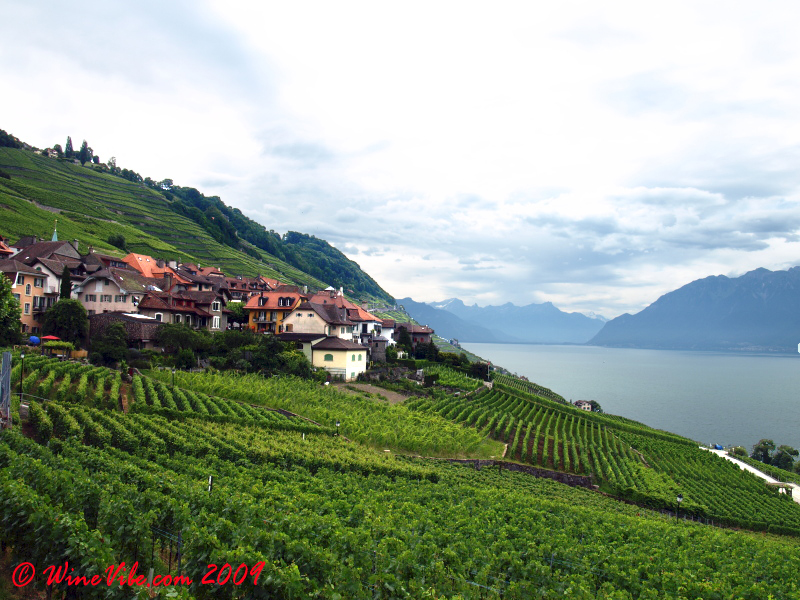
lavaux vineyards
Vineyards of Lavaux , Vaud, Switzerland

How much wine does Switzerland produce?

To put Switzerland’s wine production into perspective, I will compare it with California. Switzerland produces around 1.1 million hectoliters (29 million gallons) of wine a year. California, on the other hand, produced around 20.6 million hectoliters (545.8 million gallons) in 2008. In other words, Swiss wine production is only around 5% of California wine production. Clearly, Switzerland’s wine production is significantly less than California’s. Nevertheless, if you figure in Switzerland’s population, you’ll realize that Switzerland actually produces a lot of wine. Specifically, it produces more than 4 gallons or 21 bottles of wine per inhabitant.

How much wine does Switzerland export?

Over 4 gallons of wine per capita seems plenty, especially since people below 18 normally do not drink wine. Switzerland probably exports most of it – or does it, really? Well, it does not. Swiss wine export is actually very limited. It’s just supply and demand. Swiss people drink 4 times more wine than Americans do. In fact, Switzerland has to import around 1.7 million hectoliters of wine (45 million gallons) just to satisfy its people’s demand for wine. In short, residents of Switzerland love their wines so much that they leave very little available for export. Switzerland exports only 1.5% of the wine it produces. In contrast, according to the US Department of Commerce, California exported over 21% (3.8 million hectoliters or 100 million gallons) of its wine production in 2006. So, why do we know so little about Swiss wine again? Simple. Virtually all of it is consumed domestically. Not a lot of people outside Switzerland get to try it, let alone know about it.

Interesting trivia: Even though the demand for Swiss wine is very high, Swiss wine prices remain reasonable. Most Swiss wines are priced at the $12-$30 range.

Swiss wine varietals

Switzerland is most well known for growing Chasselas, a white grape variety often used as a table grape in Europe. For some reason (climate/soil), Chasselas has found a perfect home in Switzerland. Swiss Chasselas wines are delicate and elegant with great minerality. At first, it was thought that all Swiss Chasselas wines are best drunk young (within the first 2 years). However, sommeliers have discovered that some Chasselas wines 15 years and older from great producers and vintages actually drink very well. These vintages are creating beautiful, mature Chenin Blanc/Viognier-type wines. Switzerland is home to many indigenous varietals and has cross-cloned numerous varietals as well. Some 190 varietals are grown in Switzerland today. The most commonly cultivated are (in order of importance and categorized by wine type):

Reds:

Pinot Noir (52%), Gamay (19%), Merlot (12%), Gamaret (4%), Garanoir (2%), Syrah (2%)

Humagne Rouge, Diolinoir, and some fifty plus, non-listed varietals account for 9%

Whites:

Chasselas (66%), Muller-Thurgau (8%), Chardonnay (5%), Sylvaner (4%), Pinot Gris (2.5%)

Amigne, Pinot Blanc (Malvoisie), Charmont, Humagne Blanche, Petite Arvine, Riesling, Gewürztraminer, Heida (Paien) and some seventy or so non-listed varietals account for 14.5%

Swiss vines go back as far as 3,000 BC. According to records, Swiss viticulture and wine production began at the time of the Roman Empire. We owe today’s incredible terraces of vineyards in the Lavaux area to the monks. Some of these vineyards are now UNESCO World Heritage sites (enlisted/inscribed in 2007, UNESCO ref 1243).

More Swiss wine facts and trivia to come

This is just the start. Expect more blog posts about my trip into the heart of Switzerland’s wine production areas.

Cheers!