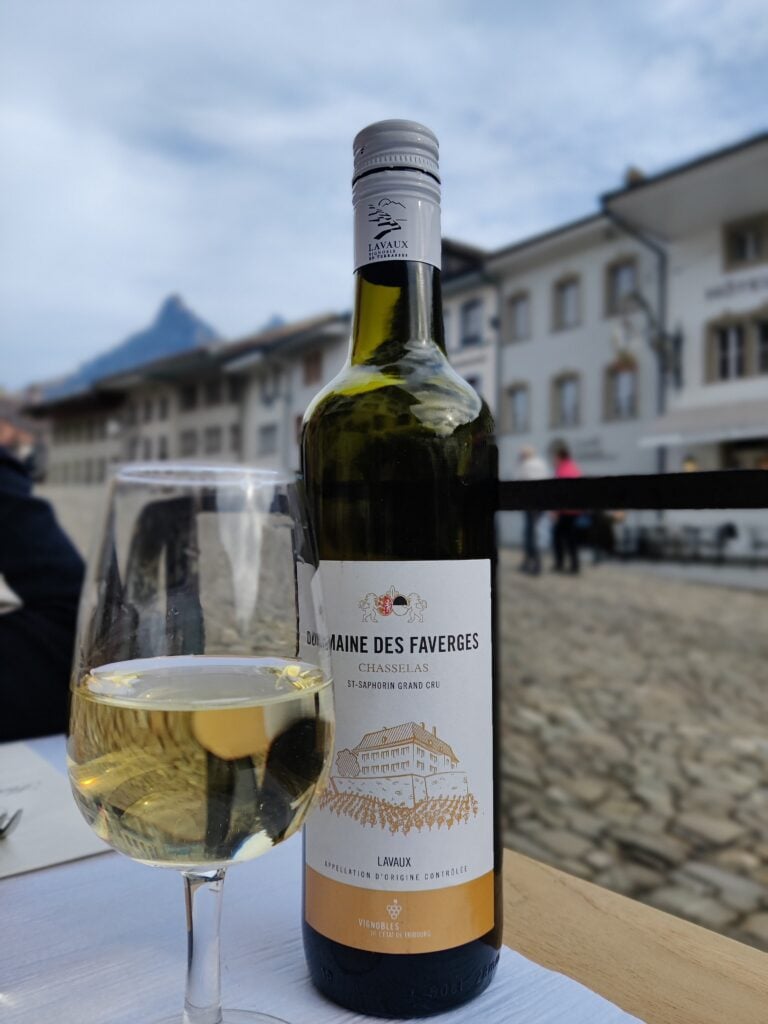
I was sitting with a glass of Chasselas from Lavaux, poured from a bottle labeled Domaine des Faverges, when the back label stopped me: Vins de l’État de Fribourg. A wine from Vaud’s most famous vineyard, made by the State of Fribourg. That deserved a closer look.
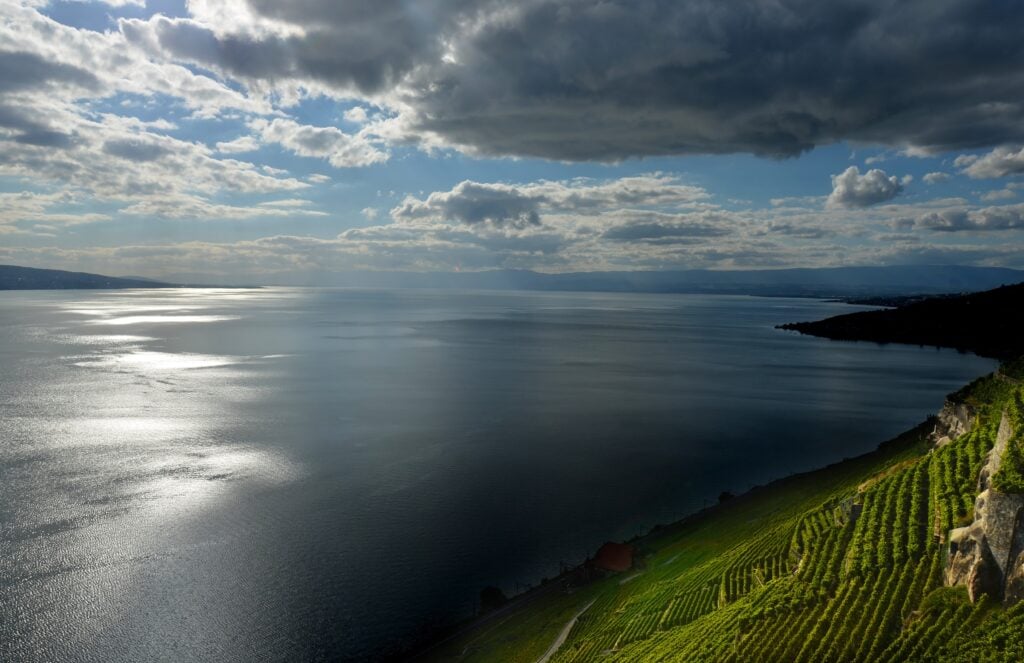
For those who don’t know it, Lavaux is a UNESCO World Heritage site and one of the great wine landscapes of Switzerland. Its stone-walled terraces drop straight into Lake Geneva, with the Alps across the water. Every vine on those slopes sits in the Canton of Vaud. Yet one of its oldest estates belongs to a neighbouring canton, and the reason goes back almost nine centuries.
The Monks of Hauterive, 1138
The story starts with Cistercians, not politicians. In 1138, monks from the Abbey of Hauterive, near Fribourg, settled on the land at Faverges, given to them by Lord Guillaume de Glâne. They cleared the slope, built terraces and planted vines.
That was standard Cistercian practice. The order needed wine for the Mass and for its own table, and it had the labour, patience and discipline to farm land nobody else could. The Lavaux terraces we admire today are, in large part, their engineering.
Hauterive held Faverges for roughly 700 years. Generations of monks worked the same steep parcels, long enough for an abbey near Fribourg to become a fixture of Vaud’s wine country.
From Abbey to State: 1848 and 1867
The break came with the political upheavals of the 1840s. In 1848, Fribourg’s radical government dissolved the abbey and confiscated its property, Faverges included. The vineyard now belonged to the State of Fribourg.
It did not stay that simple. When the conservatives returned to power, the confiscation was reversed in principle. The land could not be handed back in kind, so the Canton settled the debt instead: in 1867 it paid 435,000 francs in bonds to the diocesan authorities. That payment is the formal acquisition, and it is why Fribourg marks its ownership of Faverges from both dates.
So Fribourg never bought its way into Lavaux. It inherited an abbey’s vineyard through a political fight at home, then paid to make it legitimate.
The Other Fribourg in Lavaux
There is a second Fribourg owner on these slopes, and it is easy to confuse the two. The City of Fribourg, through its Bourgeoisie, has its own estate in Lavaux, and it is even older.
In 1362, the last lords of Billens sold their vineyards at Riex to the young city-state of Fribourg for 680 Lausanne pounds. The city handed them to the Hôpital de Notre-Dame, one of its civic institutions, the same year. Today the Domaine de la Bourgeoisie farms 6.15 hectares across Epesses, Dézaley and Vevey-Montreux, and its range includes a Dézaley Grand Cru.
That is the medieval purchase story, and it is real. It simply belongs to the City, not the Canton. Two Fribourgs, two estates, two separate histories, both still making wine in Lavaux.
Faverges Today
Domaine des Faverges covers 15.4 hectares above Saint-Saphorin. For decades the Canton leased it to winegrowing families, most recently the Vallélian and Regamey families. Since November 2025, the State runs it directly, from vineyard to sales, with its own team in the cellar and the vines.
The estate has converted to organic farming, which on these terraces means more passes through the vines and more frequent, natural treatments. The 2025 vintage was the first made in a largely modernised cellar of about 110,000 litres.
The buildings are getting the same attention. A CHF 17.6 million restoration, begun in 2023, adds event and conference space and a winegrower’s house for tastings, with completion planned for 2027. The results are already in the bottle: the Canton’s wines have taken Mondial du Chasselas medals, and the Réserve du Conseil d’État placed first at the Swiss organic wine competition.
In the Glass
Lavaux is Chasselas country, and Faverges is no exception. Chasselas is a quiet grape. It carries little aromatic weight of its own, so it shows the site with unusual honesty.
On these slopes you get the textbook Lavaux profile: lime blossom and white flowers, fresh almond and hazelnut, and a saline, stony finish. The lake reflects light and heat back onto the vines, and the stone walls store warmth into the night, so the wines gain body without losing their tension. Good examples age far better than their reputation suggests, turning honeyed and nutty with a few years in bottle.
Lavaux also grows small amounts of Pinot Noir and Gamay for light, fruit-driven reds. They are worth trying, but Chasselas is the reason to come.
Final Sip
Fribourg’s place in Lavaux is not a quirk of modern politics. It is the residue of nine centuries: Cistercian monks who built terraces, a radical government that seized them, a conservative one that paid for them, and a city that bought vines of its own in 1362.
Today the Canton is investing as if it means to stay another few hundred years. Organic farming, a rebuilt cellar and direct management are not the moves of an owner keeping a museum piece.
Next time you pour a Faverges, read the back label. You are drinking Swiss federalism, with a saline finish.
Cheers!
Sources
- Canton of Fribourg: 150 years since the acquisition of Domaine des Faverges
- Fribourg Region: Vins de l’État de Fribourg
- Le Courrier: Saint-Saphorin, a new era at Domaine des Faverges
- Fribourg Region: Vins de la Bourgeoisie de la Ville de Fribourg
- Lausanne Tourisme: Domaine de la Bourgeoisie, City of Fribourg
- Canton of Fribourg: first place at the Swiss organic wine competition
- Canton of Fribourg: Mondial du Chasselas medals for the State vineyards