Posts Tagged ‘Valais’

Le Mondial du Pinot Noir 2010

December 23rd, 2010 by Sébastien Gavillet

What would you call spending 3 days in the incredibly beautiful district of Sierre, sampling the best Pinot Noir wines the world has to offer? I’d call it heaven, but the VINEA Association calls it by a more earthly name: Le Mondial du Pinot Noir.

A Brief Background

Le Mondial du Pinot Noir is an international wine competition organized by the VINEA Association.

Side note: The VINEA Association is publisher of the Swiss Wine Guide and organizer of the world-renowned Swiss Wine Fair (held every September) and the Swiss wine competition, Grand Prix du Vin Suisse. Since 2006, it has managed the administrative side of the World Federation of Major International Competitions for Wines and Spirits (VinoFed). The VINEA Association organizes two prestigious international wine competitions, Le Mondial du Pinot Noir and Le Mondial du Merlot (which it co-organizes with ISICOM SA). Both of these competitions are members of VinoFed and enjoy the patronage of the International Organization of Vine and Wine (OIV) and the Union Internationale des OEnologues (UIOE).

Le Mondial du Pinot Noir is a competition focused on the Pinot Noir variety and other Pinot varieties (Pinot Gris and Pinot Blanc). Every year (starting from the very first Le Mondial du Pinot Noir in 1998), winemakers from various Pinot Noir-growing regions worldwide would gather in Sierre to present their best Pinot Noir appellations for sampling and judging by a panel of highly skilled international tasters.

The competing wines are tasted and judged using an evaluation sheet that combines the OIV form and the UIOE form for international competitions. The competition is organized strictly according to the rigorous standards set by the OIV. A computerized system is used to ensure that the competing wines are evaluated and rated in an orderly and systematic manner. The fairness and credibility of results are guaranteed; the composition of wine-tasting panels and awarding of prizes are in strict compliance to VinoFed’s rules and standards.

Side note: Wondering why Pinot Noir wines deserve special attention? Pinot Noir, with a total surface area of 85,000 hectares worldwide, is a very unique variety. Pinot Noir wines are exceptionally expressive of terroir and their producers’ vine-growing and winemaking techniques. Le Mondial du Pinot Noir, therefore, serves as a venue for wine producers to showcase their terroir and winemaking skills. Those who can produce the best expressions of Pinot Noir are rewarded with the worldwide recognition they deserve. Pinot Noir lovers, on the other hand, leave knowing which Pinot Noir wines they must absolutely try next.

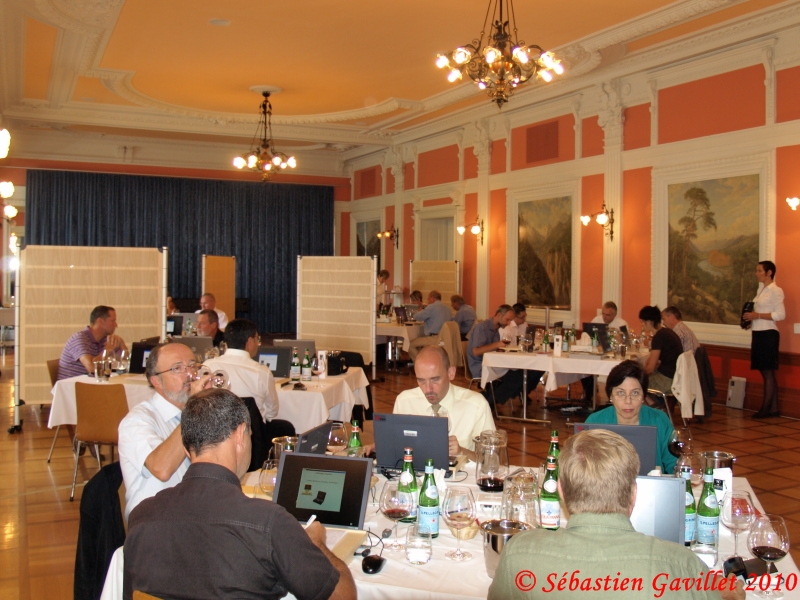
This year, Le Mondial du Pinot Noir was held from the 20th to the 22nd of August at the Chateau du Mercier in Sierre, Valais Switzerland – and I’m glad to have been part of it.

The Wines

A little over 1,100 Pinot wines of different vintages, colors (red, white and rosé) and styles (dry, sweet, still, and sparkling) from 21 countries competed. The wines were grouped into three major categories: the Mondial du Pinot Noir Category, the Pinot Family Category and the Pinot Noir Producers World Champion Category. Le Mondial du Pinot Noir is mainly a Pinot Noir wine competition, but Pinot Gris and Pinot Blanc wines have a special place in the Discovery subcategory (under the Pinot Family major category).

At stake were gold medals, silver medals and the various special prizes: the Univerre Trophy prize, the Bourgogne d’Aujourd’hui prize, the Older vintage prize, the VINOFED prize, the Producers of Pinot Noir World Champion Syngenta prize and the Vitisphere for Digital Communication prize.

The jury was composed of 60 experienced wine tasters from Argentina, France, Germany, Italy, Malaysia, Netherlands, New Zealand, Romania, Sweden, Switzerland, and the United States

The Royal Treatment

I was one of the members of the jury, and this was my first time attending a VINEA function as a judge.  Although I’ve heard numerous accounts of how Le Mondial du Pinot Noir is always so superbly organized, the event still exceeded my expectations.

Top marks go to the competition’s organizers. Their excellent planning, outstanding preparation and faultless execution ensured the smooth flow of activities and made the event what it was: a huge success. Their impeccable hospitality, moreover, made for a truly memorable 3 days.

The organizers gave me and the rest of the jury a taste of the region’s history and culture by taking us on a tour of the nearby museums. We visited Fondation Pierre Gianadda and enjoyed the Nicolas de Staël Exhibition (this temporary exhibition will end on November 21st ). We also made a special trip to Chateau d’Aigle, a 12th century fortress towering over rows and rows of vines and home to The Vine and Wine Museum.

The organizers also treated our palates to the best food and wine the region has to offer. The most memorable are the Chamoson Raclette dinner set amidst the world’s oldest Petite Arvine vineyards (owned by Rene Favre & Fils) and the luncheon at Hotel Le Terminus’ gourmet restaurant, Didier de Courten (rated 2 stars by the MICHELIN Guide and 19 points by Gault Millau).

Le Mondial du Pinot Noir was truly a treat. I enjoyed every minute I spent walking around the beautiful Sierre countryside with its lovely weather, stunning mountain vistas and endless vineyards. I loved sampling the Pinot Noirs and other Pinot varietals, and I deeply admire the wine producers’ dedication to bringing out the best in these varieties. Most of all, I appreciate the warm hospitality the people of Sierre and the VINEA Association have shown me and my fellow members of the jury.

Pinot producers, do you think you make one of the world’s best Pinots? There’s only one way to find out. Enter your wine(s) in Le Mondial du Pinot Noir! For more information about Le Mondial du Pinot Noir, please visit www.mondial-du-pinot-noir.com.

Cheers!

Jean-René Germanier – Switzerland’s Premier Boutique Winery

May 19th, 2010 by Sébastien Gavillet

As I continued my journey into the heart of Switzerland’s only Grand Cru wine making area, I met up with Gilles Besse of Cave Jean-René Germanier. He is, in my humble opinion, one of Switzerland’s top wine makers.

The Jean-René Germanier Winery

La Cave Jean-René Germanier was established in 1886 when Urbain Germanier planted his first vineyards and founded a winery in Vétroz, a small village at the very heart of Valais (see the post about Rene-Favre & Fils Winery for more information on this region). Today, 3rd- and 4th-generation oenologists Jean-René Germanier and Gilles Besse produce wines that rival those of the world’s best producers, although Jean-René Germanier – while still very much involved and passionate about wines – now spends most of his time playing politics as he is a member of the Swiss Parliament. Apart from wines, the Germanier Estate is also known for its remarkable eau de vie (i.e. fruit brandy). Another Germanier ancestor, Francis Germanier, was the first to make eau de vie from the now-famous Williams pears, giving birth to Germanier Estate’s Bon Père William.

The Germanier Wine Varietals

The Jean-René Germanier Estate produces both white wines and red wines. The following is a list of the grape varieties used in making Germanier wines:

White wine varietals

Red wine varietals

Remarkable Germanier Wines

Jean-René Germanier & Gilles Besse have achieved star status in Switzerland and around the world for their superb, award-winning wines. Cayas, Champmarais and Mitis are just three of these notable Germanier wines.

Cayas Syrah Du Valais: Wine Review and Tasting Notes

Cayas Syrah Du Valais is a Syrah varietal red wine. It resembles any great Rhône Côte-Rôtie or Crozes-Hermitage wines, but surpasses most of them.

Cayas has an intense garnet robe. It is very elegant; the nose is complex yet surprisingly delicate for such a full-bodied wine. It presents the aromas of blackcurrant, blackberry, redcurrant, some spice (with hints of licorice and pepper), leather, vanillin, and a touch of earthy mineral-like notes.

There’s an almost-perfect balance between acidity and tannins, which gives Cayas a surprisingly crisp and harmonious finish for a Syrah. To put it simply, this is the type of wine you can drink, glass after glass, without having to force yourself one bit.

Proof of its excellence can be seen in all of its awards. Among its many awards is a Gold Medal in Vinalies Internationales Paris and a Gold Medal as well as the distinction of being one of the Top 10 Best Syrahs in Syrah du Monde 2009. It is also the only Swiss wine you’ll find in the wine list of the famous La Tour d’Argent in Paris.

As you all know, the purpose of my visit into the Swiss wine country is to introduce you and the rest of the world to unique Swiss wines. As remarkable as Cayas is, it’s still a Syrah varietal – and Syrah is not a grape variety native to Switzerland.

If you are hankering for wines uniquely Swiss, then you’d love my discussion of the next two Germanier wines: Cornalin de Champmarais and Mitis Amigne De Vétroz.

Cornalin de Champmarais: Wine Review and Tasting Notes

Cornalin de Champmarais is a red wine. As its name suggests, it is made using the Swiss wine grape, Cornalin.

Now, as anyone who has had Cornalin wines would tell you, wines made of Cornalin often have a great nose and superb finish but tend to be lacking on the mid-palate. Not this time, though. You’ll be pleasantly surprised with Champmarais, which embodies all of the positive characteristics of the Cornalin varietal but none of its faults. No wonder Cornalin de Champmarais belongs to the growing list of Germanier wines with a Gold Medal from Viniales Internationales Paris.

Cornalin de Champmarais owes its full body from superior wine grapes and a unique fermentation and maturation process. At Cave Jean-René Germanier, the grapes used all come from a single vineyard, ensuring great grape quality control. These select Cornalin grapes are fermented in 400-liter barrels made of new oak. The resulting wine is then aged, again in 400-liter new oak barrels for 2 years.

Champmarais is a day-bright, pigeon-blood-red wine with purple hues. It is a rich, complex and highly fragrant wine with excellent aging potential. It presents the aromas of raspberry, blackcurrant, morello cherry, and hints of spices (peppercorn, vanilla). On the palate, the wine is elegant and velvety, with the fruit and wood tannins perfectly integrated. This is one wine you’ll find very hard to enjoy in moderation.

Mitis Amigne De Vétroz: Wine Review and Tasting Notes

Mitis Amigne De Vétroz, an Amigne varietal white wine, is another premium wine from the Germanier Estate. This sweet dessert wine, made using botrytised grapes, is aged on its lees in new oak for up to 18 months. It can rival any top-of-the-line Austrian and German wine of the same style. In fact, Mitis Amigne De Vétroz 2007, has just been awarded a Gold Medal in Vinalies Internationales Paris 2010.

This amber-colored, full-bodied wine presents the aromas of quince comfits, linden, honey-roasted hazelnuts, a touch of Cointreau-like orange peel, and a hint of vanilla bud. This succulent wine enrobes your entire palate, leaving a smooth but lingering caramel or toffee finish. In a word, Wow! Just writing about it is making me salivate.

The Germanier Cellars and Winery

All Germanier wines are made, aged and bottled at the Germanier Estate. Red and white wines are kept separate, and each has its own dedicated “caretaker.” The Jean-René Germanier Winery is a modern production facility. It has undergone some renovations over the years to meet the ever-increasing demand for its wines. More changes are expected to be instituted in the near future.

Germanier wines are available for sale at the tasting room, which is elegant and spacious enough to accommodate large parties. If you are ever in the neighborhood, I urge you to take the time to visit the Jean-René Germanier Winery and sample its wines. You can tell them I sent you.

Just one thing, though: please drink responsibly. There are just so many great wines in that tasting room you’ll find it very hard to spit all of them out. Can’t or won’t take my word for it? You can ask my father who was with me on this particular visit. Let’s just say he had a little too much to drive… Cheers!

Rene Favre & Fils – The Princes of Petite Arvine

May 06th, 2010 by Sébastien Gavillet

My journey into the Swiss wine country included a stop in St. Pierre-de-Clages, a village in the municipality of Chamoson in the canton (state) of Valais. There, I met up with Mike and John (Jean-Charles) Favre of the Rene Favre et Fils (Rene Favre & Sons) winery.

The Wine Region of St. Pierre-de-Clages, Chamoson

The wine-growing area of St.Pierre-de-Clages and Chamoson is the largest in Valais and home to around 30 different wine grape varieties. The soil in this area is mostly limestone. The vineyards are situated on the right bank of the Rhone River, and most of them are on gentle slopes. The unique location of the St.Pierre-de-Clages – Chamoson vineyards gives them a southern exposure that makes the proper maturation of wine grapes possible, and it is at the heart of this exceptionally located wine-growing region that you’ll find the Rene Favre & Fils Estate.

Rene Favre & Fils Winery

The Rene Favre & Fils winery specializes in Petite Arvine wines produced from the world’s oldest Petite Arvine vines. This family winery is currently run and operated by the Favre brothers, Mike and John.

John Favre first studied at the agricultural school of Chateauneuf in Valais. Next, he went to L’ecole Superieure de Changins, the best viticultural and oenology school in Switzerland.

Mike Favre took a slightly different route. He studied Economics before going on to study Oenology and Viticulture in the state’s engineering school. Then, he set off to the US where he lived and made wines for 7 years before returning to Switzerland and the family estate. Today Mike is Vice President of Vinofed, among other things.

Mike and John Favre represent the new generation of winemakers. Bold, forward-looking and passionate about their wines and vines, they are revolutionizing the industry by introducing and applying new techniques to viticulture and winemaking.

The Favre Vines

The Favre vineyards are easily identifiable by the way the vines are planted. Specifically, the vines are arranged into two tight rows and one larger row (see picture gallery).

The vines were planted this way mainly for efficiency. This configuration gives grape pickers better access to the grapes. It also makes the vines more accessible to a specialized machine that removes extra leaves. The removal of extra leaves increases air flow within the canopy. This helps prevent rot and other vine diseases and, consequently, the Favres don’t need to use pesticides on their vines.

The Favre vines are, in fact, some of the cleanest I have ever seen (see it for yourself by checking the picture gallery), and I have seen plenty in my trips to vineyards worldwide.

The Favre Wines and Wine Production

The Rene Favre & Fils winery produces a diverse range of wines. Their white wine production consists mainly of Petite Arvine, Johannisberg (Sylvaner) and Fendant (Chasselas). Their red wine production, in turn, consists mainly of Pinot Noir, Gamay, Humagne Rouge, Merlot, Syrah, and Diolinoir.

All Favre wines are made in the estate, and all of them are fermented in stainless steel vats. Most of the whites never see oak, but all the reds do. The profiles of Favre wines are typical of the region, with the exception of a few blends which Mike and John have produced for a more international palate.

My personal favorite in the Favre white wine lineup is the “old vines” Petite Arvine (i.e. Petite Arvine wine made with grapes harvested from very old Petite Arvine vines). This wine is fresh with a medium body and balanced acidity. It has the aromas of lemon, grapefruit rind and rhubarb and some floral notes, too. It also has noticeable minerality (limestone) on the palate and a pleasant touch of salinity.

My favorite Favre red is the Renommée St. Pierre, which is surprisingly rich and fruit driven for a Suisse Pinot Noir. This is wine aged for 18 months in oak, and I highly recommend it to any Pinot lovers.

This is all for now. Watch out for more posts about Swiss winemakers and Swiss wines. In the meantime, you can read the first two installments in the Swiss wine series: Swiss Wine Facts and The Adrian and Diego Mathier Winery.

Cheers!

The Adrian and Diego Mathier Winery

March 23rd, 2010 by Sébastien Gavillet

As you know from my post, Swiss Wine Facts, I have been to Switzerland recently. There I met with half a dozen winemakers and visited their wineries. The Adrian and Diego Mathier Estate was one of the wineries in my itinerary.

The Mathier Family and their Estate

The Adrian & Diego Mathier Estate is located in Salquenen, in the Swiss Canton of Valais. The Mathier family has been living in this wine producing village since 1387. The Mathiers have been making wine for four generations. Their domain extends to a total of 25 hectares (62 acres) of vineyards in Salquenen and Chamoson.

Wine is more than just a business to the Mathiers. It is their way of life. As with other Swiss wine producers, quality is the Mathier winery’s topmost priority.

Distinctive Salquenen Soil

Salquenen soil is unique in Valais. Salquenen soil is rich in lime and magnesium. On the other hand, the soil in most other wine producing areas of Valais consists of slate and gravel.

Winemaking Particularities

The grapes are not crushed. A centrifuge is used to separate the grapes from their stems. After fermentation, the grapes are pressed using a pneumatic press (applying pressure not exceeding 1.5 bars).

The Mathier Estate practices what I call “individual plot fermentation,” which is when grapes from a certain area (plot) of a vineyard are selected to be fermented by themselves rather than in a mixture with all the grapes of the same varietal harvested from the entire vineyard. This lets the Mathiers “experiment” and/or separate better quality grapes from lesser ones.

The Mathier family does not chaptalize their wine. Mathier vineyards get close to 330 days of sun per year! Additives may be added or used in the course of winemaking. Such additives include yeast, sulphur dioxide, carbon dioxide, calcium dioxide, and fining agents.

Wine may or may not be aged in oak. When it is, a type of French oak is used. Specifically, the Mathier family uses Quercus petraea (Sessile Oak) and Quercus robur (Pedunculate Oak).

Wine Production

The Mathier family produces more than 45 different types of wine and distillates. One of their most notable products is Glacier Wine (vin du glacier), a late harvest (noble rot) wine stored in ice chambers dug right into the Aletsch Glacier. These ice chambers make a perfect storage for late harvest wine. The ice acts as an electromagnetic shield, protecting the wine. This plus the low ambient temperature (just above freezing level) and the highly humid air all work together to preserve the wine.

The Mathier family’s wine production facilities are modern and very well maintained. (No surprise there; this is Switzerland, after all.) There are small, stainless steel tanks which the Mathiers use for individual plot fermentation (see the “winemaking particularities” section). Over the last few years, the winery’s facilities have undergone massive construction/renovation. This modernized operations and increased productivity without sacrificing quality.

The Adrian & Diego Mathier tasting room is open to the public. So the next time you are in Switzerland and find yourself in Valais (perhaps you’re on your way to visit the alpine resort of Crans-Montana or Zermatt – home to Switzerland’s, if not the world’s, most famous mountain, Matterhorn – or maybe you’re just traveling by train to Italy), be sure to make a quick stop in Salquenen and sample some of Adrian & Diego Mathier’s award-winning wines (that’s 150 gold medals over the years). I highly recommend it!

Cheers!