Posts Tagged ‘wine aromas’

Wine Aromas – Le Nez du Vin

June 29th, 2010 by Sébastien Gavillet

People often ask me how I can be sure that the aromas I say I smell are what they are and not another. “Is it really strawberry instead of raspberry?” they ask.

I can understand why people feel the need to ask this question. All too often, wine aromas are confused or misinterpreted, making it difficult to identify the wine being described. So, just how does one learn to accurately distinguish and describe wine aromas?

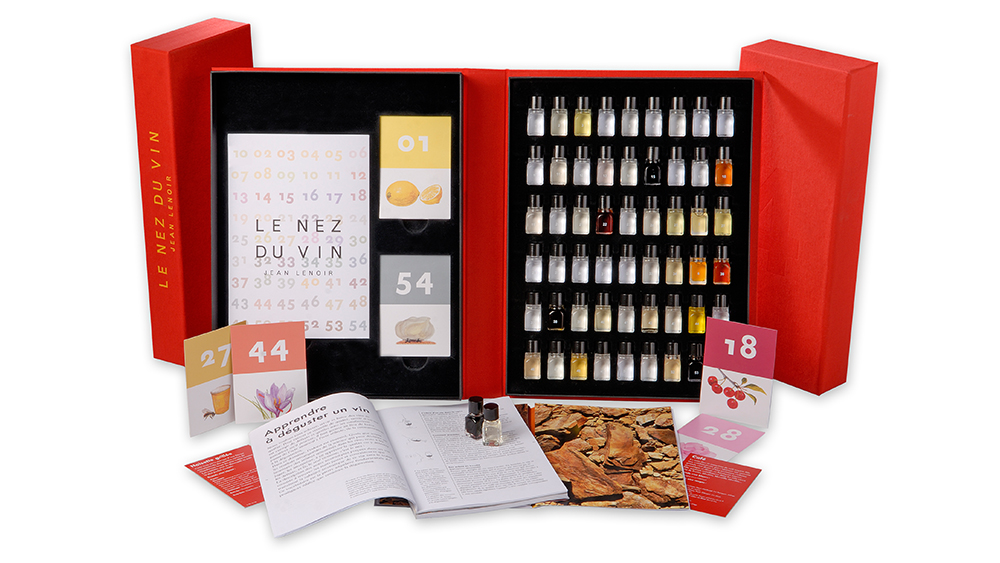
In my professional opinion and based on my personal experience, the simplest way to learn to differentiate the aromas in wine is by using the Wine Aromas’ (Le Nez du Vin) wine education kit developed by Jean Lenoir. But we’ll return to that later. For now, let’s discuss where wines get their aromas, and how professional wine tasters describe wine aromas and why they describe them this way.

Where Wines Get Their Aromas

Wines, or more specifically the grapes used to make wines, take on the characteristics of their environment (in wine speak, that’s terroir). In the earth (i.e. soil), air and water are aromatic compounds. The soil and water also contain the essences of plant and floral life that have been layered over through the centuries. These are the exceptional aromas found in red and white wines from France and around the world.

A wine’s aromas can give us an indication of this wine’s country, region and vineyard of origin. They also tell us about the grape varietal/s used to make the wine, the winemaking techniques utilized and the aging conditions to which the wine has been subjected.

An Explanation of Wine Aromas and How Wine Tasters Describe Them

When professional wine tasters say they detect the strawberry aroma in a particular wine, they are not saying that the maker of the wine added strawberry essential oils to the grape juice (i.e. that the wine is a strawberry-flavored one). They are simply saying that the wine has a scent that closely resembles that of strawberries.

In truth, wines owe their aromas from their chemical composition. It is not just one chemical compound that can lead to a particular aroma, moreover. A specific wine aroma can be a result of one or a combination of several compounds. For instance, there are a number of compounds (individually or in combination) that can give wines strawberry-like aromas – and these include Furaneol, ethyl acetate, ethyl butyrate, ethyl formate, ethyl hexanoate, and methyl cinnamate.

Professional wine tasters, however, do not mention these compounds in their wine reviews. For example, they simply say they smell strawberries instead of saying the wine has Furaneol or any of the other compound with which the strawberry aroma is generally associated. This makes it easier for the readers of wine tasting notes to assimilate and use the provided information in their wine buying decisions. What professional wine tasters do, basically, is assess a wine’s aromas and describe them in a manner that laypersons (non-professionals) can easily understand.

Example:

Isn’t it easier to imagine how a wine would be like if we read a tasting note that describes it using words in our everyday vocabulary? Take the following sample description of a Nuits-St-Georges Premier Cru:

This red wine, garnet in color with pinkish meniscus, has the aromas of strawberry, raspberry, cherry, and liquorice with some smoky notes. The wine is balanced with a smooth lingering finish.

The above description is clear, simple and very easy to understand, right? Now, imagine how so much more complicated and unfathomable this review of Nuits-St-Georges Premier Cru would be if wine tasters wrote the following way:

This red wine, garnet in color with pinkish meniscus, has the aromas of one or more of the following: Furaneol, ethyl acetate, ethyl butyrate, ethyl formate, ethyl hexanoate, methyl cinnamate (Strawberry), ethyl acetate, ethyl formate and esters (Raspberry), Benzaldehyde-cyanohydrin (Cherry), Glycyrrhyzin (Liquorice), Guaiacol, and 4-ethylguaiacol (Smoke). The wine is balanced with a smooth lingering finish.

Is your head aching yet? With a description like the above, only someone with a degree in chemistry could possibly imagine what this wine smells like. Any wine taster that writes his tasting notes this way will quickly (and deserves to) lose all of his readers, subscribers and followers.

The Wine Aromas Wine Education Kit

Now, let’s go back to our original question. Just how do we learn to distinguish and name specific wine aromas? The answer is simple: use the Wine Aromas (Le Nez du Vin) wine education kit.

Wine Aromas - Le Nez du Vin 54 Aroma Master Kit

The Wine Aromas (Le Nez du Vin) wine education kit is an essential tool for anyone who wishes to learn how to accurately identify specific aromas in wine. Through its help (and with time and practice), you will learn the universal language of wine, become skilled at accurately pinpointing wine aromas, and become good at identifying the type and origin of whichever wine you are sampling. Ultimately, the Wine Aromas wine education kit will improve your appreciation for wines.

For more information about Wine Aromas / Le Nez du Vin, please visit www.winearomas.com.

Cheers!

Disclaimer: Sébastien Gavillet (the author of this article) is the Chief Wine Officer of Wine Aromas Inc, the official distributor of Le Nez du Vin wine education kits.

Great Match Wine & Tapas ’08 Wine Tasting

May 25th, 2008 by Sébastien Gavillet

Wine & Tapas ’08, the 15th annual Great Match Spanish wine tasting event, showcased more than 250 Spanish wines, representing a large chunk of Spain’s 67 denominations (DO).  The event was extremely well-organized, and I am already looking forward to next year’s Great Match.  Great Match wine tastings are held yearly to give wine professionals and the press the chance to preview the latest wines from Spain.

As you can imagine, there was no way I could sample all of the 250 Spanish wines that were featured at the tasting.  I narrowed my selection to about 100 wines which I had heard/read about or which had been recommended to me by other wine professionals.  Even with my significantly narrowed selection, however, it took me five hours before I could finish tasting all 100 wines and leave for another wine tasting event (the Moet & Chandon tasting at the all-new Trump International Hotel & Tower in Las Vegas).  Of course, I did not spend all five hours tasting wine; I also spent some time speaking with the winemakers and representatives of Spanish wine companies.

Wine Reviews and Wine Tasting Notes:  My Top 26 Spanish Wines

I cannot possibly write extensive wine reviews of all the wines I tasted at the Spanish wine tasting; that would take days to accomplish.  You are welcome to contact me, however, if you want to know about a particular Spanish wine that was presented at the tasting as I did make extensive wine tasting notes about the wines I sampled.

In this post, I have categorized the wines into wine types and/or wine styles.  The wines below are my personal favorites, and they are listed in NO PARTICULAR ORDER.  The following are wines that I plan to buy for my personal consumption and wines that I would recommend to my clients.  There is also a section called “Spanish Wines with Funky Aromas,” under which are listed wines with different or unique aromas.

Note:  The wine prices indicated below refer to the manufacturer’s suggested retail price (MSRP) provided by the Great Match organizers.

Cava (Sparkling):

  • Mont Ferrant Blanes Nature 2003, DO Cava, Wine Price: $19.99

White Wines:

(Drink Albariño wines young; they lose their appeal through time; 2-3 years at most)

  • Terra Firme 2007, DO Rías Baixas, 100% Albariño, Wine Price:  $55.00
  • Albariño Santiago Roma 2006, DO Rías Baixas, 100% Albariño, Wine Price:  $55.00

Wine tasting notes:  Unique style; handpicked grapes are cryo-frozen to delay fermentation process.  Malolactic fermentation cut at 70% via temp. control; aged 3 months on its lees; fermentation process is finished once bottled; no oak.

  • Paco y Lola 2007, DO Rías Baixas, 100% Albariño, Wine Price:  $55.00

Wine tasting notes:  Crisp and well-rounded, this is the most refreshing Albariño I’ve ever had.  Only 30% of the best harvested grapes are used to make this wine.  It has plenty of floral aromas and good acidity.  No oak.  Can’t wait to have this wine again; I’ll have it with some Asian cuisine.  Perhaps I’ll sip it plain while I’m relaxing on my patio.

Rose Wine:

  • Gran Feudo Rosado 2007, Bodegas Julian Chivite, DO Navarra, Grenache, Wine Price:  $19.00

Red Wines:

  • Montecastro y La Planeta 2002, DO Ribera del Duero, 100% Tinto Fino (local Tempranillo), Wine Price:  $55.00
  • Pasanau Finca La Planeta 2002, DOCa Priorat, 80% Cabernet Sauvignon, 20% Grenache, Wine Price:  $60.00
  • Finca Antigua Crianza 2004, DO La Mancha, Tempranillo Blend, Wine Price:  $15.00
  • Mascun 2005, Bodegas Osca, DO Somontano, 100% Syrah, Wine Price:  $25.00
  • Matamangos 2003, Agricolas Santa Rosa, DO Almansa, Blend of Grenache/Monastrell, Wine Price:  $29.00
  • Fra Guerau 2003, DO Montsant, Grenache/Syrah, Wine Price:  $15.00
  • Rento 2003, Grupo Matarromera, DO Ribera del Duero, Tinto Fino (local Tempranillo), Wine Price:  $75.00
  • Val de los Frailes 2003, DO Cigales, Fino (local Tempranillo), Wine Price:  $70.00
  • Campo Viejo Reserva 2005, Juan Alcorta, DO Rioja, 75% Tempranillo, 15% Graciano, 10% Mazuelo (Carignan), Wine Price:  $12.99
  • Ysios 2001, DO Rioja, Tempranillo, Wine Price:  $29.99
  • Navarro Lopez Old Vines Crianza 2002, DO Valdepeñas, Tempranillo, Wine Price:  $12.99
  • Rentas de Fincas 2003, DO Rioja, Tempranillo, Wine Price:  $14.00
  • Earth 2.0 2003, DO Navarra, 50% Temp, 50% Merlot, Wine Price:  $21.00

Dessert Wines:

  • Seleccion Especial 2005, Jorge Ordonez, DO Malaga (Muscatel), Wine Price:  $20.00
  • Don PX Gran Reserva 1979, Bodegas Toro Albala, DO Montilla-Moriles, Pedro Ximenez, Wine Price:  $60.00
  • Sandeman Character Medium Dry Amontillado, DO Jerez-Xeres-Sherry, Palomino Fino and a hint of Pedro Ximenez, Wine Price:  $19.00
  • Lustau Peninsula Palo Cortado, Emilio Lustau, DO Jerez-Xeres-Sherry, Palomino Fino, Wine Price:  $21.00
  • Sandeman Royal Esmeralda Amontillado VOS Sherry, DO Jerez-Xeres-Sherry, Palomino, Wine Price:  $22.00
  • Domecq Venerable Vintage 30 years, DO Jerez-Xeres-Sherry, Pedro Ximenez, Wine Price:  $45.00

Spanish Wines with Funky Aromas:

  • Protos Verdejo 2007 (white wine), DO Rueda, Wine Price:  $12.00

Wine tasting notes:  This wine has not only the expected floral aromas but also some funky, armpit-like aromas, making this wine my funky pick of the Great Match wine tasting.

  • Don Olegario Albarino 2005 (white wine), DO Rías Baixas, Wine Price:  $22.00

Wine tasting notes:  This wine has chimney-like taste / aromas all over it that are quite similar to what you will find in a Haut-Brion Blanc even though the wine characteristics are completely different; worth the experience.

Are you thinking of building up your wine collection?  Perhaps, you have no wine collection to speak of and are thinking of starting one.  Why not stock up your wine cellar with Spanish red wines?  Most Spanish red wines, especially sherry, age very well.  I recommend that you slowly start stocking up on a few cases of Spanish wines before they become more popular, hence, more expensive.

Cheers!

George M. Taber Lecture: To Cork or Not to Cork

March 18th, 2008 by Sébastien Gavillet

George M. Taber, the famous author of the book, Judgment of Paris, spoke at a lecture organized by Deluca Liquor & Wine.  You can read more about the Judgment of Paris and the Paris Wine Tasting of 1976 in the post entitled “George M. Taber Lecture:  Judgment of Paris.”

George Taber’s new book, To Cork or Not To Cork, was the focus of this lecture.  This book is about the problems associated with the use of cork.  It also presents the various wine closure methods that can serve as an alternative to wine cork.  The pros and cons associated with these methods are also discussed.

I have not read this book yet, so I will not discuss it here.  Let me just say that there really is no perfect cork, as George so unequivocally stated; otherwise, there would be no such thing as “cork taint” in today’s wine.

Australian Wine and Cork Taint

This is my two cents on why Australian wines are the world’s most corked (i.e. cork tainted) wines.

In my opinion, it is not the long journey from Portugal to Australia since South American wines do not suffer from this issue.  I think the problem originates from the Australian Customs’ practice of fumigating all incoming containers that contain wood or wood-based products.  Perhaps, the corked wines problem in Australia is related to the fumigation process.

Did I hit the nail on the head with my theory?  Until next time!  Cheers!

Wine Aromas vs. Wine Bouquet: What is the difference?

March 04th, 2008 by Sébastien Gavillet

Is there a difference between aromas and bouquet in wines?  Yes, there is.  The difference is distinct, but it can be really confusing to differentiate aromas from bouquet.  Even the most famed wine critics sometimes confuse these two.

Wine Aromas:  General Classification

Wine aromas may be classified into three major categories:

  • Primary aromas. They are also known as varietal aromas.  These aromas come from or are determined by the type of grapes (grape varietals) used in wine making.
  • Secondary aromas. These are also known as vinous aromas.  These aromas develop during the pre-fermentation and fermentation process.
  • Tertiary aromas: These aromas are developed during the post-fermentation process.  They develop when wine is being matured in the wine barrel (e.g. oak barrel) or being aged in the wine bottle (bottle aging).

Aromas versus Bouquet

To be precise, when a wine specialist talks about a wine’s aromas, he is referring to that wine’s primary and secondary aromas (i.e. varietal aromas and vinous aromas).  When he talks about a wine’s bouquet, he is referring to that wine’s tertiary aromas.

To put it even more simply, while it is true that there are three main aromas in wines, only the primary and secondary aromas qualify as “aromas” in wine lingo; the tertiary aroma is referred to as “bouquet.”  That, in a nutshell is the difference between aromas and bouquet.

Bouquet

Wines owe their bouquet to the post-fermentation and the maturing process.  The bouquet is developed only during the post-fermentation stage and in the wine bottle itself.  Aldehydes and esters are formed during the oxidation of the fruit acids and alcohol in the wine bottle.  As such, bouquet takes time – years, actually – to develop.

A good, mature wine will have a complex bouquet.  After all, a wine’s bouquet is a combination of aromas bundled together to form new aromas (you could call it perfume, if you want).

I have here a list of the common tertiary aromas found in wines.  Again, I would like to emphasize that these aromas qualify as bouquet aromas because they are developed in the post-fermentation and aging process:

  • prune
  • mushroom
  • truffle
  • cedar*
  • liquorice*
  • leather
  • toast*
  • roasted almond
  • roasted hazelnut
  • caramel
  • coffee
  • dark chocolate
  • smoke*

For more information about wine aromas, please see the works of Jean Lenoir and his must-have, world-renowned Le Nez du Vin kits.

Final Note on Aromas and Bouquet

A diligent wine critic will usually not use the word bouquet to describe the aromas found in young immature wines, unless he is describing wines of such exceptional vintage that they are already starting to show, albeit prematurely, their bouquet.

Cheers!

*Aromas that are usually developed when wine is aged in new oak barrels prior to bottling

Faults in Wine

February 07th, 2008 by Sébastien Gavillet

Today, I was asked an interesting question: How does one learn to recognize faults in wine? Fortunately, this is a million-dollar question with a $119-dollar answer – the 12-Aroma Faults Kit at WineAromas.com. This affordable wine faults kit is a great tool for anyone who wishes to learn how to sniff out faulty aromas in wines.

Why Do You Need an Aroma Faults Kit?

It is said that approximately 8% of all wines are faulty, yet less than 1% is returned at the point of purchase. There are two main reasons for this. First, there are those who drink faulty wine without noticing the fault or without being able to pinpoint the particular fault. Second, there are those who drink faulty wine, notice the fault, but do not bother returning the wine bottle.

The wine faults kit will teach you how to recognize faulty wine aromas. With practice, you will be able to determine whether or not a certain wine has a faulty aroma. You will also be able to recognize the particular type of faulty aroma present. You can therefore demand a replacement every time you are served faulty wine; thus, you’ll never have to drink faulty wine again.

The Wine Faults Kit

The wine faults kit is used the world over by winemakers, sommeliers, wine lovers, and some of the best wine schools like UC Davis that offer a wine education program. The 12-Aroma Wine Faults Kit, in particular, will teach you the 12 most commonly found faulty scents in wines. It also comes with a booklet that explains how these faulty aromas occur and how you can avoid or rectify them.

I must warn you; the faults kit does not smell good. It has the scents of vegetal, rotten apple, vinegar, glue, soap, sulfur, rotten egg, onion, cauliflower, horse, moldy-earth, and cork. Indeed; a faults kit session will never be mistaken for aromatherapy.

I highly recommend the faults kit to anyone who loves wines. It is definitely a worthy investment. The next time you are in a restaurant and detect a faulty aroma in your wine, you can call up the waiter or sommelier – should they have one – and you will be able to explain your concern in great and specific detail. This way, you can get a new, fault-free bottle of wine.

Important faulty wine tip: Should you detect the vegetal fault in your wine, change your wine order altogether. The vegetal fault occurs at harvest and, most likely, the entire batch of that vintage from that particular winemaker will be faulty.

Cheers!